Author: admin

  • Africa Doesn’t Need More Extraction — It Needs Partners. Why I Choose to Build, Not Take. By Anjo De Heus.

    Africa Doesn’t Need More Extraction — It Needs Partners. Why I Choose to Build, Not Take. By Anjo De Heus.

    Over the past months, as I have worked closely with several African nations — from Zambia to the Democratic Republic of the Congo — a question keeps coming up. Ambassadors, ministers, and community leaders ask me:

    Anjo, why do you do this? Why Africa?”

    It’s a fair question. Too many foreign actors come to the continent only when there is something to extract: minerals, oil, land, influence, or political leverage. The world rushes in when there is something profitable beneath the soil, but disappears when there is suffering above it.

    Yet Africa’s future will not be changed by those who take.
    It will be transformed by those who build.

    A Turning Point: Peace Talks and Resource Deals

    Recently, headlines celebrated a U.S.-brokered peace agreement between Rwanda and the DRC. On the surface, this is good news — stability is essential for progress. But beneath the diplomatic language lies a familiar pattern:

    Peace, followed by access to mineral wealth.

    Copper. Cobalt. Rare earth elements. The raw materials that fuel electric vehicles, batteries, and the global transition to clean energy.

    The question is not whether international involvement is good or bad.
    The question is: Who truly benefits?

    Because if peace is negotiated for the sake of mining contracts while the local population continues to face poverty, limited healthcare access, and unstable infrastructure, then the cycle of dependence and underdevelopment continues.

    Africa deserves more than transactional engagement.
    It deserves transformational partnership.

    What I’ve Seen on the Ground

    In Zambia, I met nurses who were fully trained but unemployed because clinics lacked funding. In the DRC, I visited communities where a simple diagnostic test could save a life — yet the nearest functioning laboratory was hundreds of kilometers away.

    These are not failures of the people.

    They are failures of global priorities.

    And they are solvable.

    Why I Choose to Work Differently

    When I founded 360Disruption, I made a simple decision:

    We will not enter a country to extract value.
    We will enter to create it.

    Our work in #Africa is built on three pillars:

    1. Healthcare access that reaches the forgotten

    Through partnerships with Oasis Diagnostics and Oludent, we focus on saliva-based molecular testing — a revolutionary approach requiring:

    • no needles
    • no cold chain
    • no specialized laboratories

    This brings diagnostics to rural populations where people today walk miles just to know what is wrong with them.

    2. Job creation through technology localization

    Local manufacturing of diagnostic kits.
    Training programs for nurses and youth.
    Community-based telehealth hubs.

    Africa does not need foreign companies to deliver finished products.
    It needs partners willing to build industries inside African borders.

    3. FDI that prioritizes human outcomes

    Foreign direct investment must do more than finance infrastructure.
    It must:

    • create jobs
    • transfer knowledge
    • strengthen local systems
    • generate long-term national capability

    Anything less is exploitation dressed as opportunity.

    The Truth About Africa’s Potential

    Africa is not “rising” — Africa has been ready.

    Ready for modern healthcare infrastructure.
    Ready for localized innovation ecosystems.
    Ready for manufacturing.
    Ready to be at the center rather than the periphery of global development.

    The world is beginning to understand Africa’s value — but primarily through the lens of minerals, extraction, and strategic leverage.

    My mission is to help shift that lens.

    What Real Partnership Looks Like

    Real partnership looks like:

    • helping a government create a national diagnostic program
    • training thousands of local health workers
    • building a manufacturing line that stays in the country
    • transferring IP, knowledge, and economic opportunity
    • ensuring rural populations receive the same care as capital cities

    It looks like a future where Africa exports products, not raw materials.
    Where African youth become biomedical engineers, not miners.
    Where data powers health decisions, not guesswork.

    This is the Africa I believe in — the Africa I know is possible.

    A Message to Global Health Innovators

    If you are a U.S., Canadian, or European health-tech innovator reading this:
    Africa is not “too difficult” or “too early.”

    It is the most important market of the next 30 years.

    Not because of what lies beneath the ground —
    but because of the talent, potential, and human capital above it.

    And if your technology can solve a problem at scale,
    Africa is where your innovation will have its greatest human impact.

    I invite you to reach out.
    Let’s build something meaningful.

    My Answer to the Question: “Why Africa?”

    Because I have seen what is possible.
    Because the need is immense and immediate.
    Because impact should not be a slogan — it should be measurable, real, and transformative.

    And because I believe that true leadership means going where others won’t — not to extract, but to build.

    Africa does not need another foreign visitor with a mining contract.
    It needs partners with integrity, courage, and a willingness to invest in the lives of people.

    That is the work I choose.
    That is the future we can create — together.

    Our doors are open, please contact us at africa@360disruption.com or visit 360disruption.com for more info and partnership opportunities.
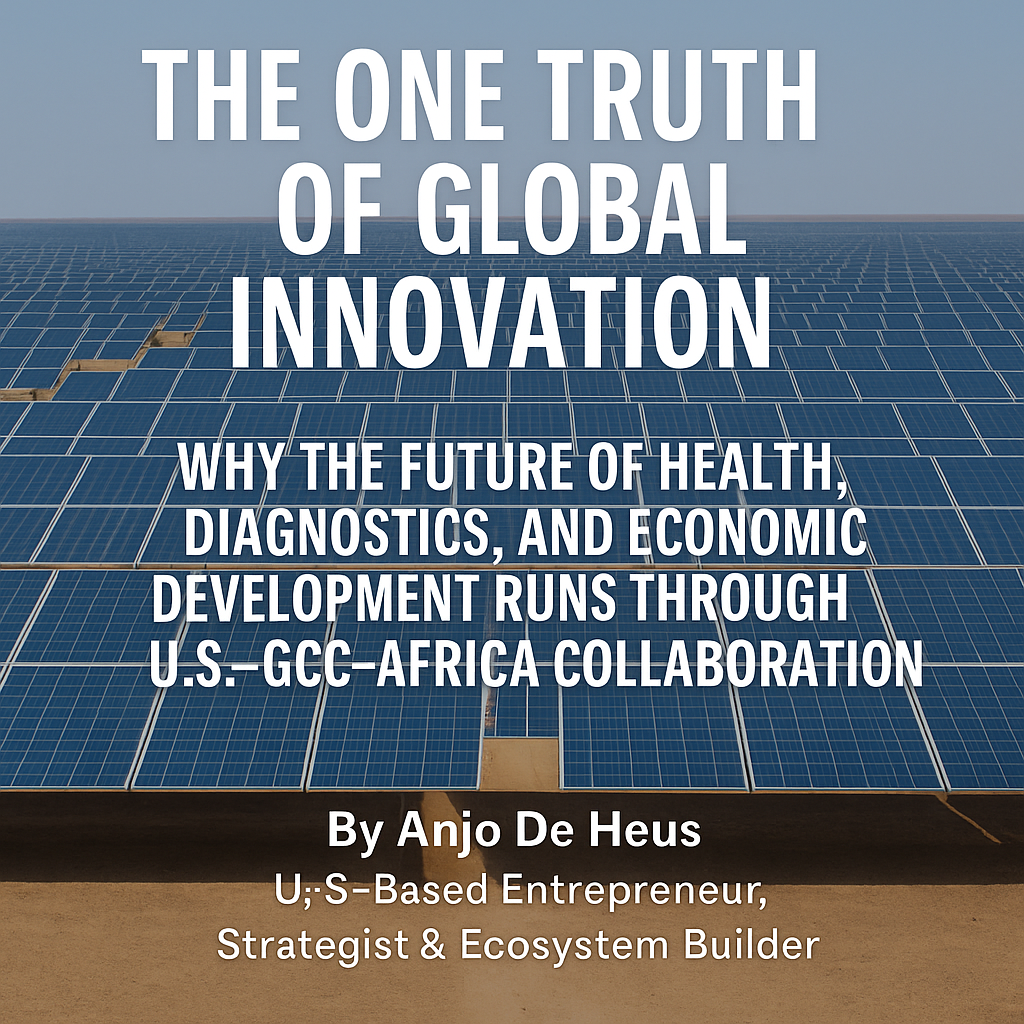
  • THE ONE TRUTH OF GLOBAL INNOVATION: Why the Future of Health, Diagnostics, and Economic Development Runs Through U.S.–GCC–Africa Collaboration

    THE ONE TRUTH OF GLOBAL INNOVATION: Why the Future of Health, Diagnostics, and Economic Development Runs Through U.S.–GCC–Africa Collaboration

    By Anjo De Heus | U.S.-Based Entrepreneur, Strategist & Ecosystem Builder

    Innovation is no longer shaped by borders — it is shaped by the flow of ideas, capital, and capability. As someone who sits at the intersection of the United States, the Gulf, and Africa, I have learned one truth that remains consistent across every market:

    Innovation only matters when it improves lives — and when people actually have access to it.

    Across healthtech, biotech, diagnostics, and sustainable development, billions of dollars of innovation remain locked in labs, research centers, and startup ecosystems. Meanwhile, entire regions still face preventable suffering simply because solutions never reach them.

    My work through 360Disruption — and the broader One Truth Project — exists to close this gap.

    1. The World’s Innovation Inequality Problem

    The U.S. leads in breakthrough technologies.
    The GCC leads in commercialization speed.
    Africa holds the greatest need — and the greatest potential for scale.

    Yet these regions rarely operate as a unified ecosystem.

    I have seen founders with diagnostic platforms capable of detecting disease early, fail to expand outside the U.S. simply because they lack market entry strategy or government access. I’ve also seen African nations struggle with diagnostics, despite being open, eager, and ready for solutions.

    This is not a technology problem.
    It’s an access problem.
    It’s a strategy problem.
    It’s a partnership problem.

    2. Why the GCC Has Become the World’s Gateway for Innovation

    Over the past decade, the Gulf has transformed itself into a global testbed for innovation.

    • UAE Vision 2031
    • Saudi Vision 2030
    • Qatar’s National Strategy
    • Bahrain’s Economic Plan

    These programs open the doors to healthtech, AI, diagnostics, biotech, and sustainability. The GCC is no longer importing innovation — it is actively shaping it.

    From a strategic standpoint, the GCC is the world’s most efficient commercialization hub:

    • Fast regulatory pathways
    • High investment capacity
    • Strong public–private partnerships
    • Regional expansion into Africa and Asia
    • Government-driven incentive ecosystems

    This is where U.S. innovators need to be, but most don’t know how to enter.

    This is where 360Disruption plays a central role:
    bridging U.S. innovation with Gulf adoption and African impact.

    3. Africa: The Continent Where Innovation Makes the Greatest Difference

    Across Africa — especially in nations like Zambia, Ethiopia, and the Democratic Republic of Congo — health systems face three urgent challenges:

    1. Access to diagnostics
    2. Limited specialist availability
    3. High disease burden with delayed detection

    The result: millions of preventable deaths and billions in economic loss.

    But Africa is also where innovation can scale the fastest:

    • Young population
    • Mobile-first adoption
    • Demand for low-cost diagnostics
    • Strong interest in public–private partnerships
    • Government readiness for modernization

    When you introduce accessible diagnostics — especially saliva-based, telehealth-enabled, and lab-light technologies — the impact is immediate and national in scale.

    This is why our partnerships with Oasis Diagnostics and Oludent Health International have such profound relevance.

    4. The New Innovation Bridge: U.S. Science → GCC Commercialization → African Deployment

    Over the past year, I noticed a pattern in the companies that reached out to me from the U.S.:

    • AI diagnostic firms
    • Molecular labs
    • Biotech companies
    • Digital health startups
    • Sustainability innovators
    • Medical device manufacturers

    None came through acquisition pipelines.
    None came through cold outreach.

    They all came through referrals, through people who had seen how 360Disruption executes, builds trust, and transforms market entry into national-scale solutions.

    This validated a truth I’ve always believed:

    People don’t buy innovation — they buy capability, integrity, and certainty.

    Through 360Disruption, companies gain:

    • A clear go-to-market strategy
    • Government access and negotiation
    • Free zone and regulatory pathways
    • Localization and partner development
    • Investment alignment (FDI, PPP, grants)
    • Rapid commercialization
    • Scaling into Africa

    This is how we build health ecosystems — not just market entries.

    5. Diagnostics Is the Frontline of Development

    If a nation can detect disease early, everything else becomes possible:

    • Healthier population
    • Higher productivity
    • Lower treatment costs
    • Better planning
    • Stronger economies

    This is why saliva-based diagnostics, telehealth platforms, mobile lab networks, and decentralized molecular testing matter so much.

    They don’t just test disease —
    they unlock national development.

    6. Why This Work Matters — Personally

    My mission is not transactional.
    It is transformational.

    I work closely with African ambassadors, GCC regulators, U.S. innovators, and impact-driven partners because I truly believe that:

    A single innovation introduced in the right way can change an entire country.

    From screening villages in Zambia to deploying diagnostics in the DRC, to enabling manufacturing footprints in the Gulf — this is not business.
    It is purpose.

    7. The One Truth

    Across every country, every sector, every conversation, I have learned the one truth that guides everything I do:

    Innovation has no value unless it reaches the people who need it most.

    This is why my work continues.
    This is why 360Disruption exists.
    This is why the One Truth Project was created.

    The mission is simple:
    Bridge innovation. Build ecosystems. Create impact.
    And do it with integrity, clarity, and long-term commitment.

    If you are an innovator, policymaker, investor, or global partner ready to build solutions that matter — my door is always open.

    This is how the future is built — together.

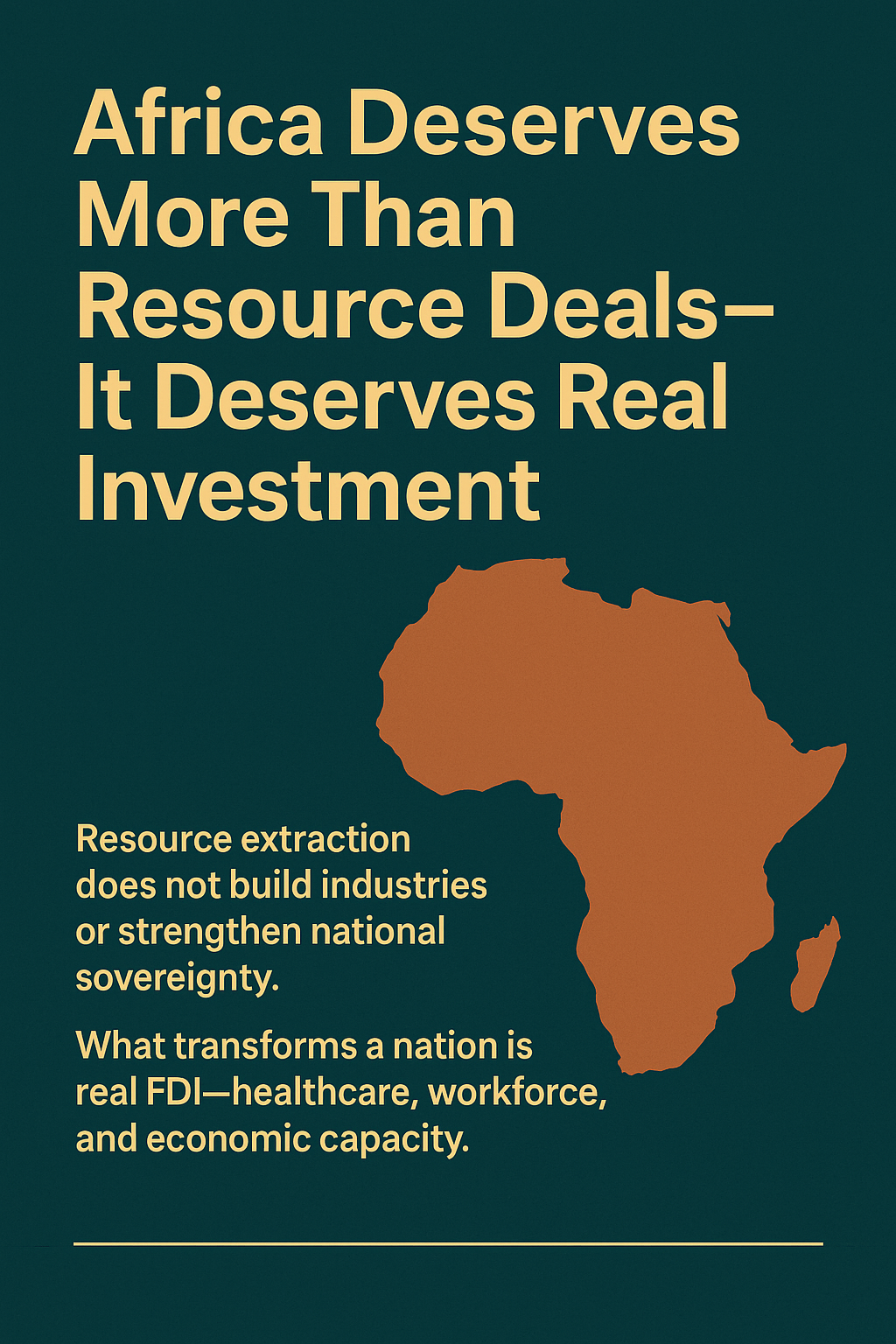
  • Africa Deserves More Than Resource Deals — It Deserves Real Investment

    Africa Deserves More Than Resource Deals — It Deserves Real Investment

    The recent peace negotiation efforts between Rwanda and the DRC are an important development for Central Africa. Stability and peace are always welcome.

    But while the geopolitical headlines focus on rare earth minerals, I believe the real opportunity for Africa lies elsewhere.

    Mineral extraction does not create prosperity.
    It does not build industries.
    It does not empower the youth.
    And it does not strengthen national sovereignty.

    What transforms a nation is real FDI — the kind that builds capabilities rather than exporting raw value.

    Through 360Disruption, I am working closely with governments, among others, in Zambia, Congo (DRC), Ghana Nigeria and Ethiopia to bring U.S. and GCC innovations into Africa:

    localized saliva-diagnostics manufacturing
    nationwide telehealth access
    diagnostic labs and reporting systems
    training pathways for nurses and youth
    investment structures that keep value inside the country

    These are the foundations of a healthier population, a stronger workforce, and a more resilient economy.

    Africa doesn’t need partners who are only after minerals.
    Africa needs partners who are after development.

    And that is exactly the work we are dedicating ourselves to.

  • Why I Created TheOneTruth.us

    Why I Created TheOneTruth.us

    A Personal Note from Anjo (Angel) De Heus

    In a world full of noise, opinions, and endless narratives, I’ve learned that there is always one truth that matters most:
    the truth of who you are, what you stand for, and the work you commit your life to.

    As my journey expanded across the United States, the UAE, the GCC, Africa, and beyond, I realized that much of my work—strategic advisory, innovation building, investment structures, and impact-driven execution—was happening behind the scenes. People often saw the ventures, the partnerships, the outcomes… but not the underlying vision or the principles that guide everything I do.

    TheOneTruth.us was created for one reason:

    To create a clear, unfiltered space where my voice, values, and mission could speak without distortion.

    Not a company page.

    Not a corporate statement.

    But a personal platform for truth, clarity, and purpose.


    1. To Establish My Own Narrative in a Complex World

    When you work across governments, investors, innovators, and global markets, information spreads quickly—sometimes inaccurately.
    TheOneTruth.us ensures that there is one source people can trust to understand:

    • what I do,
    • why I do it,
    • and what I believe in.

    It removes confusion and reinforces integrity.


    2. To Anchor My Advisory Work Under One Identity

    I advise multiple ventures and leaders across healthtech, biotech, sensors, AI, energy, and agritech.
    Different companies know me for different contributions.

    But The One Truth ties everything together under my personal mission:


    turning innovation into meaningful global impact.

    It explains:

    • Global Impact Consulting
    • Innovation Consulting
    • Investment Advisory

    All in one simple, accessible way.


    3. To Support the Next Generation of Partnerships

    Whether it’s a government engagement, a founder seeking guidance, a healthtech venture entering the Gulf, or an investor exploring the GCC—people want to know who they’re really dealing with.

    TheOneTruth.us answers that.

    It shows:

    • my philosophy
    • my approach
    • my track record
    • and my role in building bridges between the U.S., the UAE, and emerging markets

    In a world where first impressions matter, this platform builds trust instantly.


    4. To Create a Home for What Matters Most

    Over the years, I’ve learned something important:

    Businesses may change, markets shift, ventures rise and fall — but your personal truth is the constant.

    TheOneTruth.us is that constant.

    It is a reminder that everything I build is rooted in:

    • integrity
    • clarity
    • impact
    • service
    • and the belief that innovation must always serve people, not the other way around

    5. Because People Deserve the Truth — and So Do I

    At its core, The One Truth is a place of transparency.
    A place where anyone can understand:

    Who I am.
    What I stand for.
    And why I dedicate my life to building ecosystems that improve lives.

    And sometimes, the simplest websites are the ones that say the most.


    Final Thought

    TheOneTruth.us is not a brand.
    It’s not a company.
    It’s not a campaign.

    It is my anchor—a simple platform that holds everything I am building, everything I believe in, and everything I will continue to stand for.

    And that truth deserves its own home.

  • The U.S.–GCC Innovation Bridge: A New Model for Global Collaboration

    The U.S.–GCC Innovation Bridge: A New Model for Global Collaboration

    A shift is happening in global innovation, and it’s reshaping how U.S. companies scale internationally.
    Instead of expanding into saturated Western markets, founders are increasingly turning toward the GCC — a region that actively invests in technologies that accelerate national development.

    This is creating a new model of collaboration:

    1. The U.S. Provides the Innovation

    Breakthroughs in AI, biotech, diagnostics, robotics, and health platforms originate in American ecosystems known for creativity and research excellence.

    2. The Gulf Provides the Scale

    The GCC offers funding, infrastructure, supportive regulation, and a clear national vision — the ingredients U.S. companies often struggle to find at home.

    3. Both Sides Win

    • U.S. innovators gain access to markets that are modernizing rapidly.
    • The Gulf gains access to world-class technologies and knowledge transfer.
    • Long-term relationships replace one-time commercial transactions.

    4. The Model Requires a Skilled Bridge

    Success depends on someone who understands both sides —
    U.S. business culture, GCC government structures, free zones, investment pathways, and regulatory frameworks.

    This is where U.S.-based ecosystem builders and strategic advisors become essential.
    The U.S.–GCC innovation bridge is no longer theoretical — it is now one of the most effective paths to global growth.

    Learn more at https://360disruption.com

  • Why Most U.S. Startups Fail to Expand Abroad — and How to Avoid These Mistakes

    Why Most U.S. Startups Fail to Expand Abroad — and How to Avoid These Mistakes

    Going global is no longer optional for startups. But expanding into new markets is where many U.S. founders falter — not because their technology is weak, but because their strategy is incomplete.

    Here are the most common mistakes to avoid:

    1. Expanding Without Local Insight

    Market data is not enough.
    Understanding local regulations, culture, and decision-making cycles is essential.

    2. Underestimating Regulatory Pathways

    Every Gulf country has a unique licensing structure.
    Founders who expect a “copy-paste” framework from the U.S. are usually disappointed.

    3. Overreliance on Introductions

    Partnerships in the GCC require consistent follow-up and relationship development — not just a warm introduction.

    4. Arriving Without a Go-to-Market Structure

    Authorities and investors want clarity:

    • What is your rollout plan?
    • Who are your early adopters?
    • What is the localization strategy?
    • What support are you seeking?

    5. Waiting Too Long to Enter the Market

    Startups often wait for a “perfect moment.”
    In the GCC, early movers gain visibility, incentives, and credibility.

    U.S. innovators who prepare correctly — with structured partnerships and on-ground support — dramatically increase their chances of success abroad.

    Learn more at https://360disruption.com

  • The Hidden Advantage U.S. Innovators Have in the Gulf Region

    The Hidden Advantage U.S. Innovators Have in the Gulf Region

    Many American founders underestimate how valuable their expertise is outside the U.S.
    While domestic markets may feel crowded or slow, the GCC views American innovation as a premium asset — especially in fields like healthtech, biotech, diagnostics, AI, and advanced manufacturing.

    Here’s why U.S. innovators have a unique advantage in the Gulf:

    1. U.S. Standards Signal Quality

    Regulators, investors, and free zones consistently view U.S.-developed technologies as higher standard, which accelerates approvals and increases investor confidence.

    2. American Innovation Culture Is Respected

    GCC leadership values the U.S. approach to experimentation, entrepreneurship, and rapid iteration.

    3. U.S. Founders Tend to Be More Transparent

    Clear communication, documentation, and reporting align perfectly with Gulf business expectations — especially among government-linked partners.

    4. The Gulf Seeks Long-Term Value, Not Quick Wins

    This is where most U.S.-based innovators shine.
    They understand how to build systems, not just sell products.

    What many U.S. founders see as normal practice is considered exceptional in the GCC. This is the hidden advantage — and those who recognize it early are the ones who grow fastest.

    Learn more at https://360disruption.com

  • What U.S. Innovators Need to Know About Doing Business in the GCC

    What U.S. Innovators Need to Know About Doing Business in the GCC

    The Gulf region has become one of the fastest modernizing ecosystems in the world — but entering it successfully requires understanding a few essential principles that shape how business is done.

    1. Trust Comes Before Transaction

    In the GCC, relationships are built through time, sincerity, and consistent communication. Deals move faster once mutual trust is established, not before.

    2. Government Vision Shapes Market Demand

    Unlike in the U.S., where markets evolve bottom-up, many Gulf markets grow top-down. When a government prioritizes digital health, AI, or disease prevention, funding, infrastructure, and partnerships follow quickly.

    3. Execution Speed Is a Competitive Advantage

    The Gulf values partners who can move from discussion to action quickly.
    U.S. companies that bring structure, documentation, and clarity will stand out immediately.

    4. Local Presence Matters

    Even when operating from the U.S., having a trusted local representative or partner — someone who understands regulations, free-zone procedures, and cultural nuances — dramatically increases success rates.

    5. Strategic Alignment Unlocks Long-Term Opportunity

    The region is not looking for vendors; it is looking for co-creators.
    U.S. innovators who show commitment to training, localization, and shared value creation will build stronger, longer-lasting partnerships.

    Understanding these principles helps American innovators enter the Gulf with confidence and clarity — and positions them to benefit from one of the fastest-growing innovation markets of the next decade.

    For deeper insights, visit: https://anjodeheus.com and https://360disruption.com

  • How U.S. Founders Can Evaluate a Gulf Partnership Before Saying Yes

    How U.S. Founders Can Evaluate a Gulf Partnership Before Saying Yes

    Choosing the right partner in the Gulf is often the most important step a U.S. company can take. The region is rich with opportunity — but like any global market, its success depends on choosing partners who share the same level of ambition, ethics, and execution discipline.

    Below are four practical considerations that help U.S. innovators assess whether a potential Gulf partner is the right fit:

    1. Alignment With National Priorities

    Effective partners are aligned with the region’s economic and innovation strategies. If a partner references Vision 2030 or 2031 with fluency, understands local health or AI mandates, or has connections with free zones, they are likely well-positioned.

    2. Execution Capacity, Not Only Connections

    Relationships matter — but execution matters more.
    A partner should demonstrate a track record of delivery, not only introductions. Ask for examples of previous projects, regulatory experience, and on-ground support capabilities.

    3. Clarity and Transparency in Structure

    A strong partner does not avoid structure.
    They welcome MoUs, governance frameworks, commercial terms, and documentation that protects both sides.
    Structure is not a barrier in the Gulf — it is the foundation of trust.

    4. Cultural and Communication Fit

    The best partnerships succeed because both sides know how to communicate openly and respectfully. A Gulf partner who values transparency, steady follow-up, and long-term thinking will likely be a good fit for an American founder.

    Choosing the right partner is not about speed — it is about clarity.

    Insights powered by 360Disruption
    More at https://anjodeheus.com and https://360disruption.com

  • Why the Gulf Is the Next Global Launchpad for U.S. Innovators

    Why the Gulf Is the Next Global Launchpad for U.S. Innovators

    For many U.S. entrepreneurs, global expansion often begins with Canada, Europe, or the United Kingdom — markets that feel familiar and predictable. But in recent years, a different region has quietly become one of the most powerful platforms for ambitious American innovators: the Gulf Cooperation Council (GCC).

    What sets the Gulf apart is not only its economic strength, but the clarity of its long-term national agendas. Programs like UAE Vision 2031, Saudi Vision 2030, and Qatar National Vision 2030 outline precise priorities: digital health, artificial intelligence, advanced manufacturing, biotechnology, and sustainability. These are exactly the sectors where American innovators excel.

    For U.S. founders, entering the Gulf is not simply a market expansion exercise — it is an opportunity to align with governments that are actively seeking technological partnerships. Many of these countries offer simplified licensing, high-speed regulatory pathways, and incentives for companies willing to localize or transfer knowledge.

    The Gulf is not competing with Silicon Valley — it is complementing it.
    And for U.S. founders who understand how to build trust, communicate clearly, and align with these national visions, the region offers resources and scale that can accelerate growth far faster than traditional Western markets.

    Full article series at: https://anjodeheus.com